
ISSN 1671-7988 CN 61-1394/TH
创刊:1976年
Guide to Authors
-
I. Scope of Call for Papers
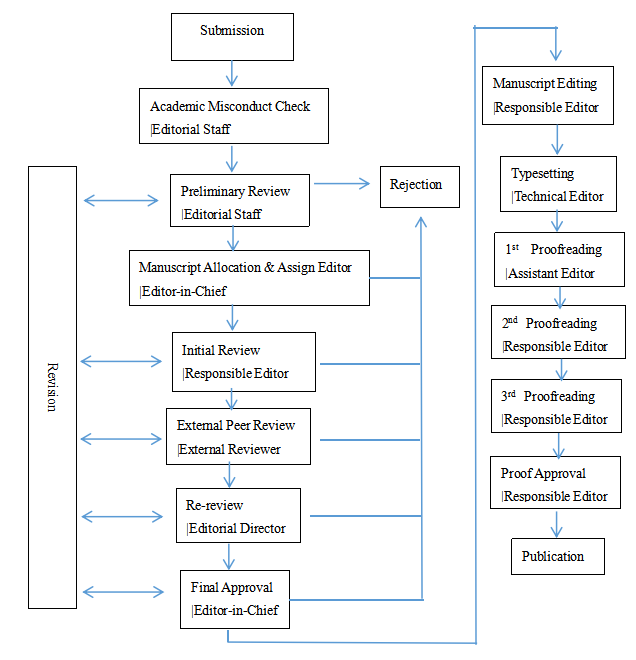
Automotive AppliedTechnology is a journal focused on automotive applications, supervised by the Shaanxi Association for Science and Technology and sponsored by the Society of Automotive Engineers of Shaanxi. It is published semimonthly. The journal welcomes original research papers, technical reviews, and industry application cases in fields such as automotive engineering, new energy vehicles, intelligent connected vehicles, automotive materials, energy conservation and environmental protection, and vehicle design and manufacturing.II. The editorial workflow of the journal is briefly outlined as follows:
III. Submission Requirements
1. Composition and Requirements of the Manuscript
Manuscripts must be original and unpublished. Simultaneous submission, plagiarism, academic fraud, and other unethical practices are strictly prohibited. Submission implies the author’s compliance with academic publishing standards. The text should be fluent, logically clear, with explicit arguments and authentic data. The main body must be written in Chinese, with a length of 6,000–8,000 characters (including figures and tables). The structural composition of the manuscript should be arranged in the following order: Chinese title, author names, author affiliations (including institution name, city, postal code), Chinese abstract, Chinese keywords, English title, English author names, English translation of affiliations, English abstract, English keywords, introduction, main body, and references. Submissions must be made through the journal’s official submission system, accompanied by complete author biographies, contact information, and funding information (if applicable).1.1 Title
(1) The title should summarize the main content of the paper, being specific and concise.
(2) The Chinese title should be in boldface, size 2, Song typeface, across the entire column. It should not exceed 20 Chinese characters.
(3) The English title should conform to English expression conventions; avoid using abbreviations not widely recognized in the field.
(4) If the paper is supported by a funded project, indicate this with a superscript asterisk (*) at the end of the title, and place the corresponding note at the bottom of the first page.1.2 Authors and Affiliations
(1) Preferably no more than seven authors and no more than eight affiliations.
(2) Author names should be listed below the title from left to right in order of contribution. All affiliations should be indicated in parentheses below the names, in the same order as the authors. Each affiliation should include a serial number (if more than one institution), the full name of the institution (down to the secondary unit, e.g., college, institute, or department), city name, and postal code. For foreign institutions, the country must be indicated. Superscript numbers corresponding to the affiliation numbers should be placed after each author’s name; if an author has multiple affiliations, the numbers should be separated by commas.1.3 Abstract
(1) Use small size 5, Song typeface, across the entire column, approximately 300 Chinese characters. Requirements: The abstract should summarize the main content of the paper, including research objectives, methods, results, and conclusions—covering the essential information and key points of the paper. Use precise and standard vocabulary and language to clearly and concisely present objective facts. The structure of the abstract should be rigorous, logical, and well-organized.
(2) The Chinese and English abstracts are the main content indexed by databases. Therefore, the quality of the abstract directly affects whether the paper is indexed and cited; authors should pay close attention.1.4 Keywords
3–8 keywords are recommended. Keywords should be standardized words or phrases, typically 3–8 in number. The content and order of Chinese and English keywords for the same paper should be consistent.1.5 Main Body
(1) The main body should be formatted in two columns. Basic theories, experimental methods, and derivations of fundamental equations already found in standard textbooks need not be elaborated.
(2) Except for the introduction, section headings within the main body should be numbered consecutively using Arabic numerals, aligned flush left. After the numeral, leave one Chinese character space before writing the heading.1.5.1 Introduction
(1) The introduction should briefly describe the background and significance of the research, summarize previous work and research status in the relevant field, and state the problems addressed in this paper. It should also include an overview of the main research content and results.
(2) The text should be concise, avoid repeating or explaining the abstract, avoid self-praise or disparagement of others, avoid promotional language, and try not to include figures or tables.1.5.2 Conclusion
Summarize the methods used and the research findings using accurate and concise language, highlighting the originality of the research.1.5.3 Figures, Tables, and Formulas in the Text
(1) Figures: Figures should be numbered consecutively throughout the text. The content of figures should be closely related to the text, and each figure should be introduced or referenced before it appears. Graphics should have clear lines, appropriate size for the layout, and a reasonable arrangement. Any labels or explanatory text within the figure should be legible. Except for physical quantity symbols and units, all text in figures should be in Chinese. Different curves in the same figure should be represented by different line types. All text within figures should be in 6-point Song typeface, with a resolution exceeding 600 PPI.
(2) Tables: It is recommended to use standard "three-line tables." Auxiliary lines may be added for clarity when content is easily confused. Tables should be numbered consecutively with Arabic numerals according to their order of appearance. Each table must have a title and be introduced or referenced before it appears.
(3) Mathematical formulas: Formulas should be numbered consecutively throughout the text. Formulas not referenced later need not be numbered. For symbols appearing in a formula for the first time, explain them one by one in the order they appear, using accurate and concise statements. Avoid using complex compound subscripts and superscripts; minimize three-level subscripts and superscripts, and reduce unnecessary derivations of formulas.1.6 References
Use the sequential coding system, formatted in two columns. Six or more references should be listed. Unpublished works cannot be included in the reference list. For references with multiple authors, list only the first three, followed by "等" (for Chinese) or "et al." (for English). The reference list should be numbered consecutively with Arabic numerals in the order each reference is cited in the paper.1.7 Author Biography
Please include the author's name, year of birth, contact address of the affiliated institution, educational background, professional title, telephone number, mobile phone number, and main research direction at the end of the article. This facilitates communication between the editorial office and the author.2. Applicable Standards
2.1 Terminology
(1) Use scientific and technical terms approved by the China National Committee for Terms in Sciences and Technologies.
(2) Use engineering and technical terminology in accordance with relevant standards or regulations.
(3) For terms without established standards or regulations, use expressions commonly recognized and understood within the field.
(4) For terms coined by the author, provide an explanation upon their first appearance in the text.
(5) Terminology used to express the same concept or combination of concepts should be consistent throughout the text.
(6) Foreign names may be kept in their original form without translation.
(7) The full names of general organizations, institutions, schools, research institutes, and enterprises must be given upon first appearance in the paper.2.2 Names and Symbols of Physical Quantities and Their Units
(1) GB 3100–1993: SI Units and Their Application.
(2) GB 31001–1993: General Rules for Quantities, Units, and Symbols.
(3) GB 3102.1~13–1993: Quantities and Units.2.3 Punctuation
GB/T 15834–1995: Usage of Punctuation Marks.2.4 Numerals
GB/T 15835–1995: Rules for the Use of Numerals in Publications.2.5 Foreign Letters
Strictly distinguish between letter types, case, roman/italic, bold/non-bold (e.g., symbols for vectors, tensors, and matrices should be in bold italic).2.5.1 Italic foreign letters are used for symbols of quantities, mainly in the following cases
(1) Variable symbols, variable subscripts, and functions.
(2) Letters representing numbers, points, lines, surfaces, solids, and figures.
(3) Parameters considered constants in specific contexts.2.5.2 Roman foreign letters are used for names and related codes, mainly in the following cases
(1) Well-defined known functions (e.g., sin, exp, ln).
(2) Mathematical constants with fixed values (e.g., e = 2.718 281 8…) and defined operators.
(3) Legal units of measurement, prefixes, and dimension symbols.
(4) Mathematical symbols.
(5) Chemical element symbols.
(6) Model numbers, codes, and material grades of machinery, instruments, equipment, and products.
(7) Hardness symbols.
(8) Foreign abbreviations that do not represent quantities.
(9) Latin letters indicating sequence numbers.
(10) Subscripts with specific meanings added to quantity symbols to distinguish them from other quantities.2.6 References
Format requirements follow GB/T 7714–2015.IV. Submission Methods and Fees
-
Review results are classified as accepted, revise and resubmit, or rejected. Authors must complete revisions within the specified time.
-
Upon confirmation of acceptance, authors are required to pay a page charge (1,800 RMB / 6,000 characters; figures, tables, formulas, etc., are converted to character equivalents based on the space they occupy). After publication, authors will receive two copies of the journal issue containing their article.
-
All accepted manuscripts will also be published in electronic journal and CD-ROM formats.
-
Submission website: www.aenauto.com
V. Publication and Dissemination
-
Automotive Applied Technology became an open-access journal starting from Issue 15, 2021. All articles published thereafter are immediately and permanently available for free reading and download on the journal's website. Articles published prior to this issue are non-open-access works, with copyright held by the editorial department, which reserves all rights.
-
All open-access articles in this journal are published under a Creative Commons license, allowing third-party users and authors to copy and distribute the work in any medium or format under the terms of Attribution-NonCommercial-NoDerivatives 4.0 (CC BY-NC-ND 4.0). As long as the license terms are followed, the licensor cannot revoke these rights. The following conditions must be observed: Users must give appropriate credit, provide a link to the license, and indicate whether changes were made. They may do so in any reasonable manner, but not in any way that suggests the licensor endorses their use. The work may not be used for commercial purposes. If the work is remixed, transformed, or built upon, the modified work may not be distributed. For more details on the Creative Commons license, please visit: https://creativecommons.org/licenses/by-nc-nd/4.0/
-
Once a paper submitted to the journal is accepted, the author transfers to the journal the entire copyright of the paper, including but not limited to compilation rights, distribution rights, reproduction rights, translation rights, online publication rights, and worldwide information dissemination rights; the right to permit domestic and international literature retrieval systems and databases to index and use the work; the right to publish and use the work in any current or future media, formats, and other languages; and the right to use the work in any manner that does not violate current or future laws of the People's Republic of China. The author may use the paper under the terms of the CC BY-NC-ND 4.0 license, may quote or translate parts of the paper in their subsequent works, or compile it into their own non-periodical collections.
-
All articles published in this journal after Issue 15, 2021 are digitally archived. Both paper and electronic versions are retained in the editorial office. To ensure data security, all information and materials, such as additional information and forms provided by authors during submission, are also backed up in the editorial office. The full text of the journal is also available for download from databases such as CNKI, Wanfang Data, and VIP.
-